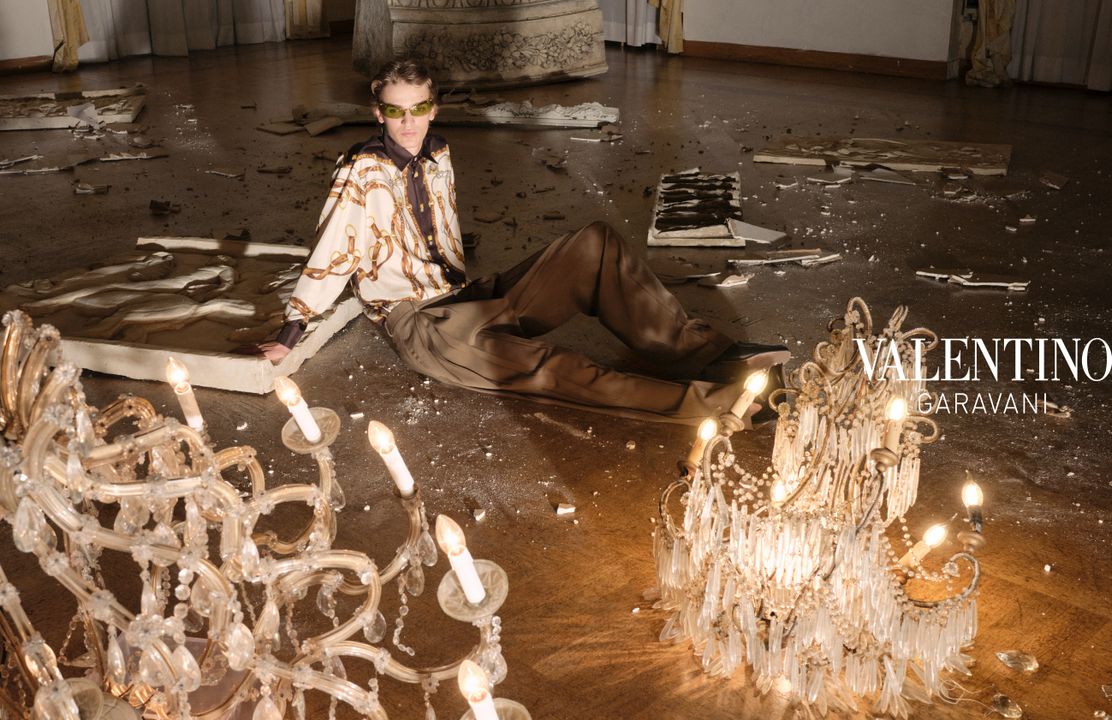
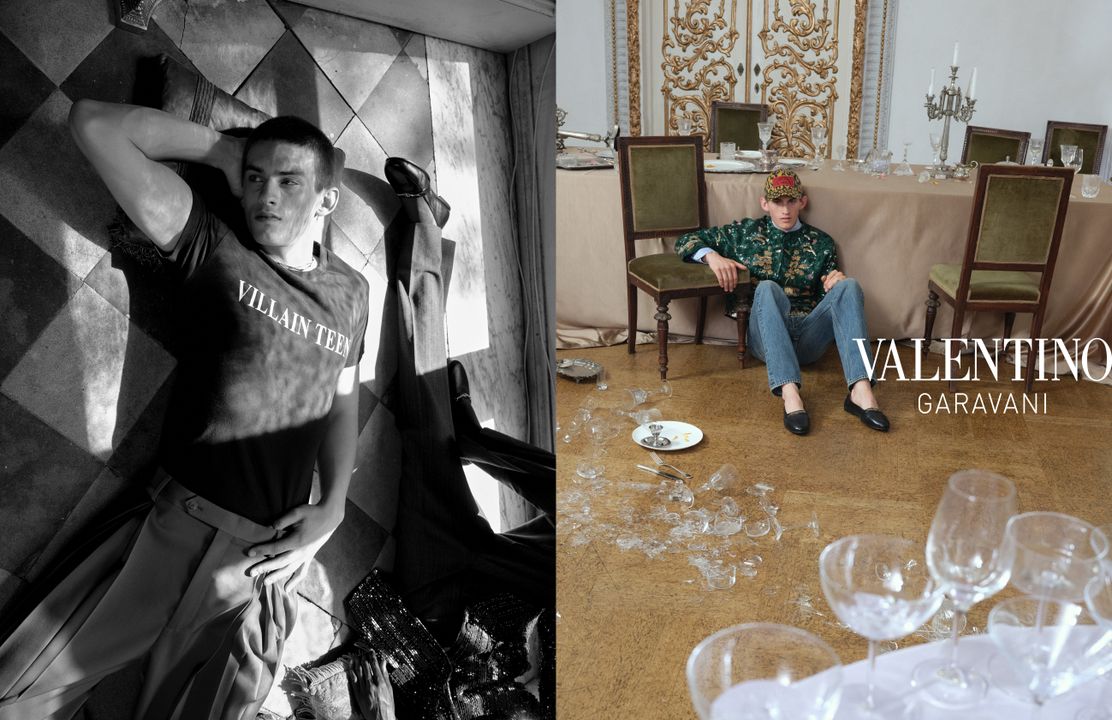

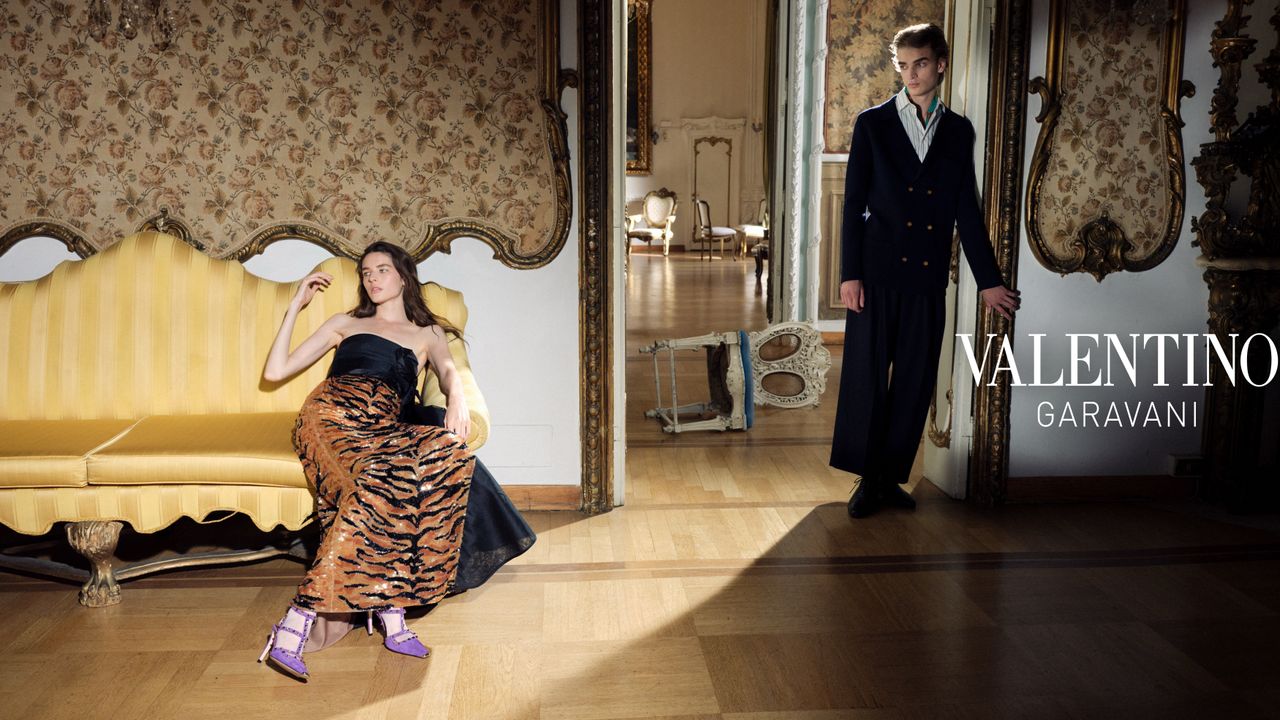
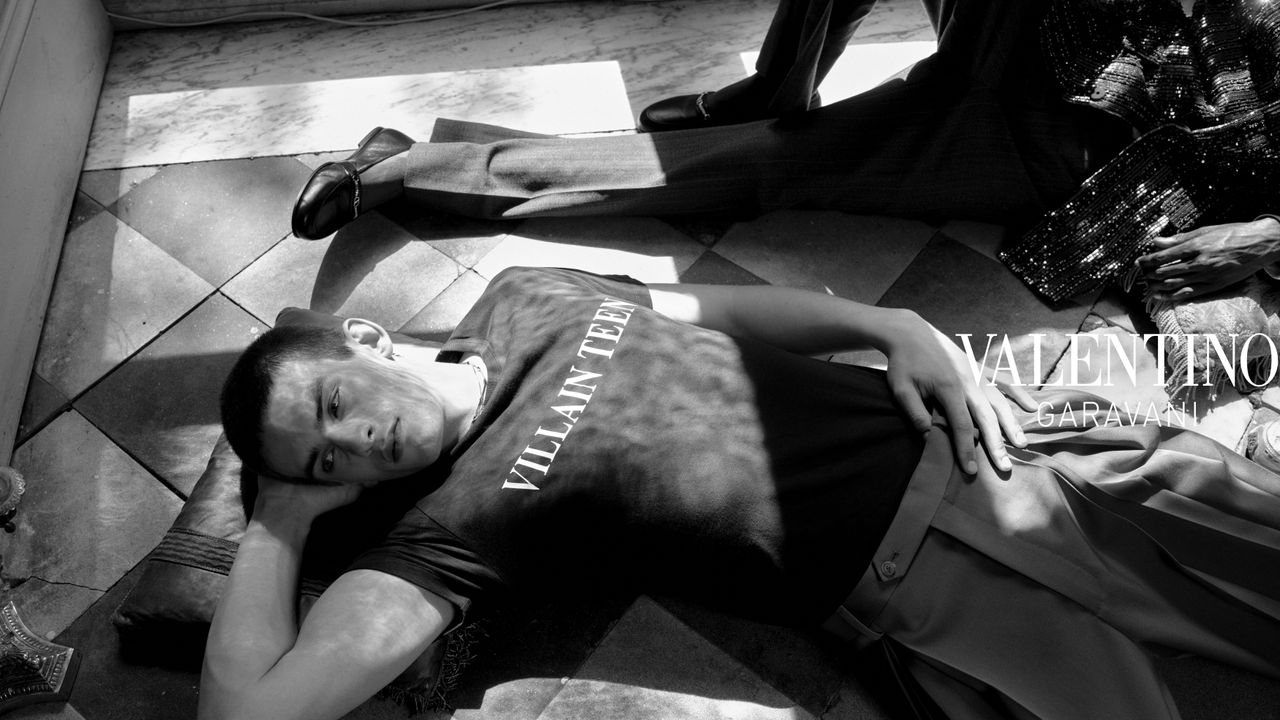

This campaign was shot in July 2026, inspired by a seemingly simple intuition: to tell the story of what remains of a party, once the party is over. That suspended moment when the euphoria has faded and the space still holds the traces of something that has already happened. Shattered glasses, fallen chandeliers, objects scattered across the floor.
Amid them, figures continue to inhabit those rooms, immersed in an atmosphere in which beauty seems to have survived the tumult of the night. It is an awakening of sorts. Their faces retain something indefinable; some bodies sink back into chairs, others remain stretched out on the floor, as though still lingering in a memory. A young woman slips her shoe back on: a small, everyday gesture, as if to recover the thread of an interrupted normality.
The party has slowly withdrawn from these figures, leaving upon them a gentle weariness, a more unguarded beauty, the uncertainty of those who do not yet quite know how to return to the world. The viewer arrives when the climax has already passed, and what remains offers itself as material for a story yet to be imagined.
This is the aesthetic of the day after, the age of consequences. A time when things seem to have lost the function that once held them in place, revealing a fragility that the splendour of the celebration had temporarily concealed. From the very beginning, this representation contained a larger question: What remains of magnificence when its rituals come to an end? What happens when a universe built around the promise of desire encounters its own vulnerability? The party thus becomes a possible metaphor for the transformations sweeping through the world of fashion: a system that has made exceptionality, exclusivity and spectacularization some of its defining codes, and that today faces a redefinition of its languages, values and its relationship with society.
The photographs evoke the possibility that an apparently unassailable order might suddenly lose its composure. And yet life continues to stir within those rooms. Beauty endures in the bodies, in the garments, in the presence of those who move through the space. Desire seeks other languages, imagines new possibilities. As though the end of a celebration, among its fragments, already held within it the promise of a new beginning.
Then, months after the campaign had been shot, something happened.
The shattered shop windows, damaged premises and clashes that had swept through several European cities suddenly began to resonate with the visual universe of the campaign. What had been conceived as the private landscape of a party’s aftermath encountered the images of a rupture that had unfolded in public space. This coincidence changed the way the photographs might be viewed, opening them up to meanings that could not have been anticipated at the time they were shot.
For a long time, I questioned whether it was appropriate to publish these images, and at one point even considered abandoning the campaign. Then I thought that openly recounting how those photographs had come into being, the intentions that had given rise to them and the questions that had shaped them, might offer an opportunity to reflect upon this unforeseen convergence. And, more broadly, upon the relationship between images and the historical time in which they are produced and viewed.
After all, the meaning of images is not exhausted at the moment of their creation: subsequent events raise new questions and change the way they are interpreted. Walter Benjamin’s reflections on the dialectical image come to mind here: that instant when what has been, encounters the present, giving rise to relationships and meanings that were previously difficult to discern. The photographs of this campaign share that same condition: conceived to give shape to an imaginary world, they confront an ever-changing reality, acquiring unforeseen, sometimes even uncomfortable associations that call upon the responsibility of those who created them.
The party is over. The chandeliers lie on the floor, the glasses are shattered. But what has happened beyond those imaginary rooms compels us to look at them differently, to confront the disquiet of the present and the transformations whose contours we cannot yet discern. It is from this awareness that we wish to begin again: from the beauty that continues to inhabit bodies, and from the responsibility of engaging with the contradictions that run through us. Even in the age of consequences, amid the fragments of what has been, the possibility of a new birth begins to take shape.
Alessandro
CONDIVIDERE