



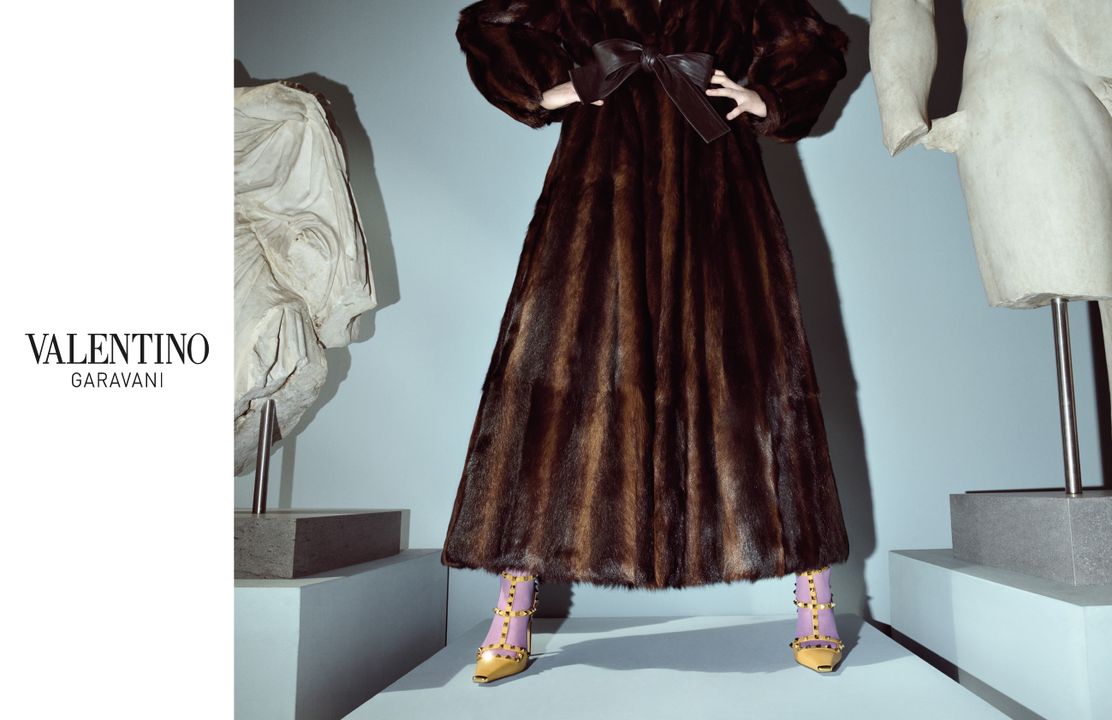
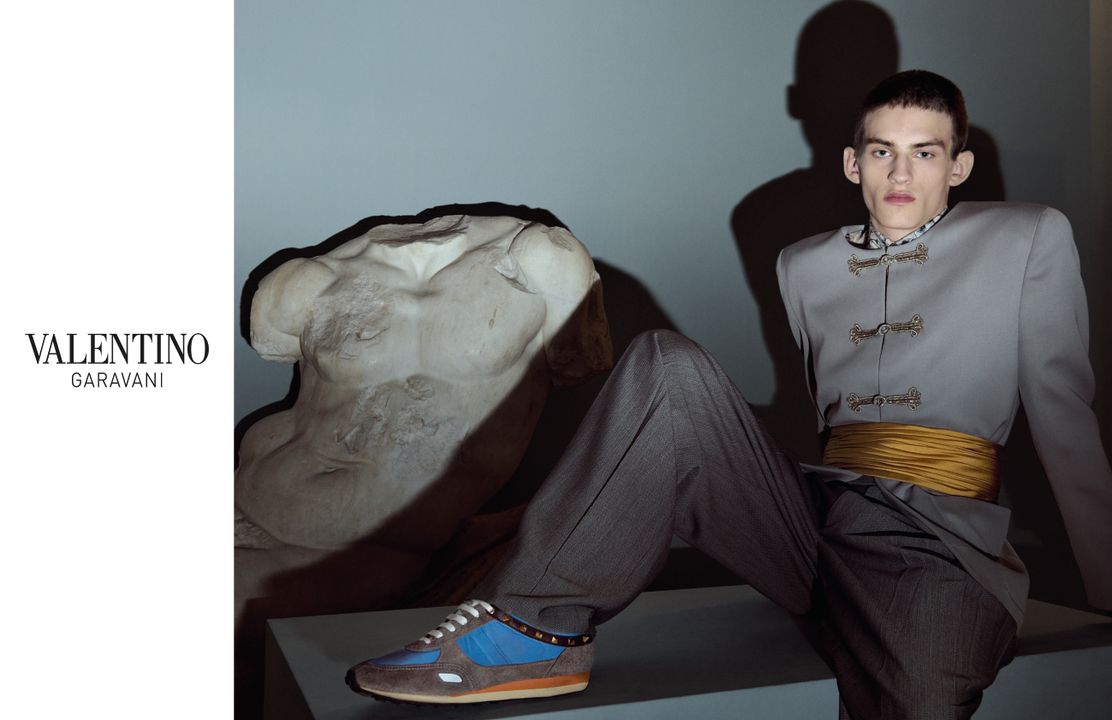
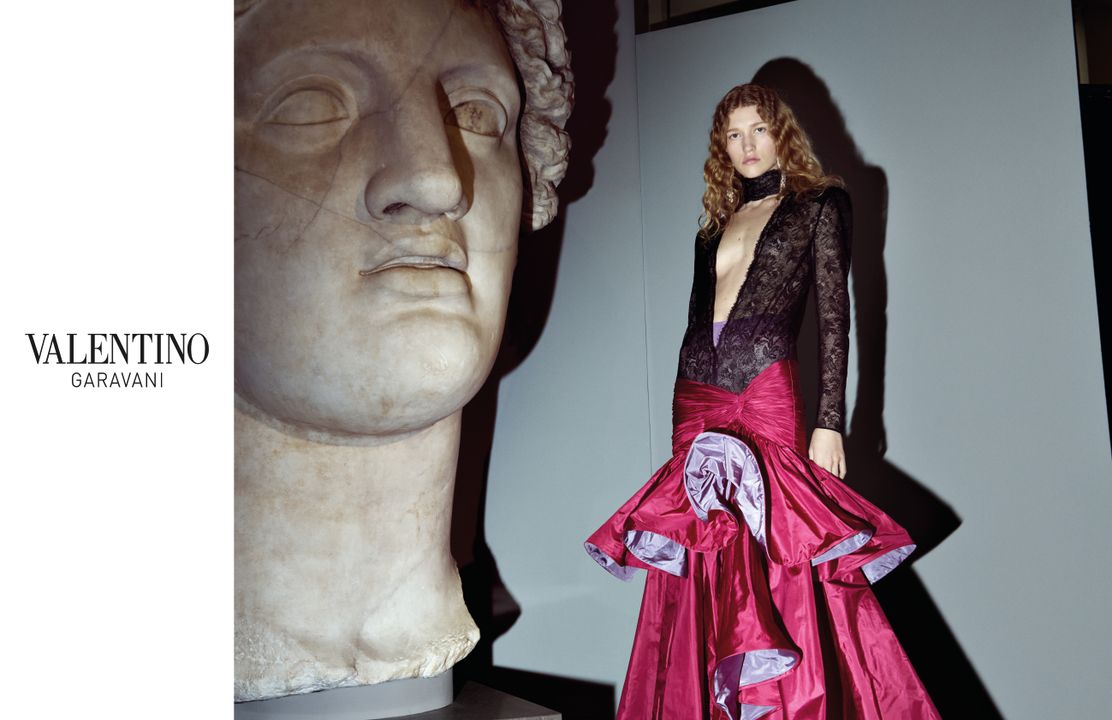

The Interferenze campaign was shot at Centrale Montemartini. Built in the early 20th century on the left bank of the Tiber, this power station was Rome’s first public electricity plant before its conversion, in 1997, into a satellite venue of the Capitoline Museums. Its hybrid nature - suspended between classical statuary and industrial archaeology - constitutes the generative principle of the campaign.
Here, the images do not simply use the site as a backdrop, they extend its internal logic. Centrale Montemartini thus becomes the stage for impossible imagination: a space where elements from seemingly incompatible worlds cease to exclude one another and instead coexist, unleashing new narratives.
Centrale Montemartini is a metaphysical place, an in-between realm where the age of gods and that of machines, myth and progress, memory and invention no longer belong to separate temporalities. Here, the classical beauty of the Roman statues resonates with the looming grandeur of turbines and boilers that powered industrial modernity.
Fragments of pagan eternity emerge among the cathedrals of technology, in a space that eludes every classification. Centrale Montemartini is more than a museum; it is an alchemical space where the fertile contagion between different worlds is continually staged.
The result of this encounter is a transmutation that does not affect the individual elements, but rather the force field generated between them. Something further takes shape, something irreducible to the mere sum of its parts. Stripped of the museum’s chronological framework, antiquity no longer belongs solely to the past; deprived of their function, machines stop being a mere residue of modernity. I
n their juxtaposition, both escape the linearity of history and are reassembled into a new constellation of meaning. From this perspective, Centrale Montemartini recalls Aby Warburg’s Mnemosyne Atlas: not so much an archive of memory, as an an apparatus of montage in which images drawn from disparate contexts, precisely through their juxtaposition, generate resonances and new possibilities of interpretation.
The goddess Fortuna, the muse Polyhymnia, and Queen Cleopatra rise among the colossal diesel engines, the alternators, the massive flywheels, and the overhead cranes of the machine hall. Here, the dialogue between the ancient statuary and the industrial archaeology transforms both.
The pallor of marble meets the opacity of cast iron, anatomical perfection challenges mechanical power, and sculptural equilibrium clashes with the monumentality of engineering. Every presence modifies the perception of the others, giving birth to a landscape where time no longer unfolds as a succession of events, but rather as a logic of co-presence. The Interferenze campaign extends this principle, translating it into a visual framing that evokes
the language of cinema.
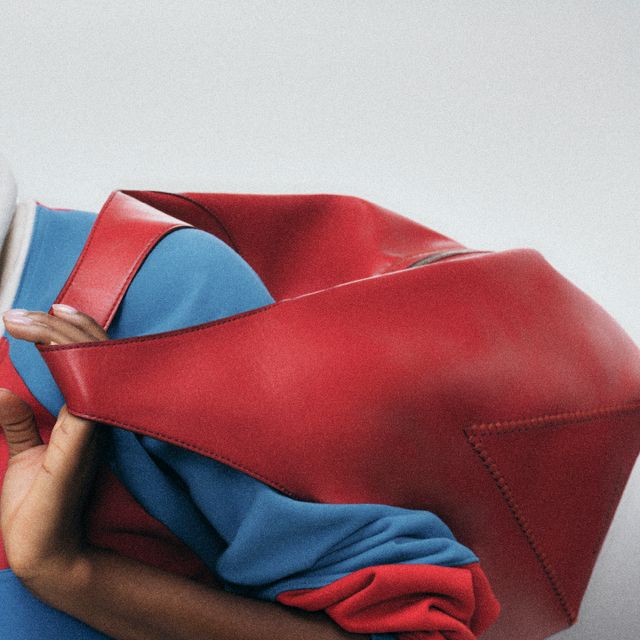
Light pierces space, sudden and swift. Fragments of bodies, marble profiles and titanic iron backbones emerge. The lightness of the garments confronts the gravity of the steel, while the gestures of the living bodies seem to extend those carved in stone. In the background, the massive machines loom silently, almost dissolved in the darkness that wraps them. Nothing appears permanently still, yet nothing actually moves.
In this suspension, each image organizes a relational field where bodies, garments, statues, and machines are put into mutual tension. The gaze finds no single focal point. It endlessly moves from one element to another, following a weave of echoes where meaning no longer belongs to individual objects, but rather to the relationships they give rise to. Sergei Eisenstein’s concept of montage offers a particularly rich interpretive lens here.
Against a linear and additive conception of composition, the Soviet director asserts that meaning does not originate from the mere sum of elements, but from their collision: the moment when divergent symbolic orders are pushed into confrontation. It is the spark generated by such a collision that makes the novel perceptual configuration possible - a configuration that cannot be reduced to its individual components.
Perhaps this is precisely what Interferenze stages. No form speaks for itself. Images emerge through their encounter with other images; matter comes into being through its relation to other matter, and time through its interference with other times. Meaning does not reside in things themselves: it lies in the space that unfolds between them. It is right there, in that interstice where conventional classifications waver, that the visible ceases to be a mere representation of the world and returns to making it imaginable.
- Alessandro
CONDIVIDERE